
- Home
- SB 1383 at home
SB 1383 at home: how to compost food waste in your kitchen
California's organic waste law changed what belongs in the trash. Here's what it asks of households, what goes in the green bin, and a kitchen setup that makes it automatic.
Updated October 7, 2026 · By the CompostFit team, San DiegoThe short answer: SB 1383 requires every California resident and business to keep organic waste — food scraps and food-soiled paper — out of the trash and put it in the organics (usually green) cart. At home, the easiest way to comply is a compost container right next to your trash that's big enough for paper plates and napkins.
What SB 1383 is
SB 1383 is California's short-lived climate pollutants law, signed in 2016. It targets methane — a powerful greenhouse gas — and one of the biggest sources it goes after is food and other organic waste rotting in landfills. The law set statewide goals to cut the organic waste sent to landfills by 75% (from 2014 levels) and to rescue at least 20% of edible food that would otherwise be thrown away.
Its regulations took effect on January 1, 2022, when cities and counties had to start providing organic waste collection to every home and business. CalRecycle oversees the program; your city or county and its waste hauler run it locally. The official overview is on CalRecycle's SB 1383 page.
What it means for your household
- Separate organics from trash. Food scraps and food-soiled paper go in the organics cart, not the trash cart.
- Use the right cart. Most jurisdictions use a green cart for organics, blue for recycling and gray or black for trash. Your hauler's guide is the final word.
- Expect checks. Haulers can inspect carts and issue contamination notices when organics are in the trash or trash is in the green cart. Local rules can attach fees to repeated violations.
- Apartments count too. Multifamily buildings must provide organics collection, so residents need a way to sort in their own kitchens.
What goes in the green bin
This is where most people are surprised: the list is longer than peels and coffee grounds.
| Green bin (organics) | Trash |
|---|---|
| Fruit and vegetable scraps Meat, fish, bones and dairy Coffee grounds and tea Bread, rice, pasta and leftovers Uncoated, food-soiled paper plates Napkins and paper towels Greasy pizza boxes and food-soiled cardboard Yard trimmings — leaves, grass, small branches |
Plastic bags and plastic wrap Foil and foil-lined packaging Styrofoam Wax- or plastic-coated plates and cups Diapers and pet waste (in most cities) Non-organic packaging |
Accepted items vary by hauler — some cities take compostable bags and certified compostable packaging, many don't. When in doubt, check your city's green-bin guide, and leave it out rather than contaminate the cart.
Why food waste matters
Food waste in a landfill is buried without oxygen, so it breaks down into methane, a greenhouse gas roughly 80 times more potent than CO₂ over 20 years. Organic waste is the largest category of material sent to U.S. landfills — about 24% of what we throw away. Sent to composting instead, the same scraps become soil amendment.
A kitchen setup that makes it automatic
The households that stick with SB 1383 sorting aren't the most motivated — they're the ones where the right choice is also the easiest. Three things make the difference:
- Put compost next to the trash. If compost lives on the counter and trash lives in the cabinet, every scrape is a decision. Side by side, it's automatic.
- Make it big enough for paper. A 1–3 gallon countertop pail can't take a dirty paper plate, so plates and napkins end up in the trash — which SB 1383 doesn't allow.
- Make it easy to empty and clean. No liners to buy, nothing to scrape, and dishwasher-safe if possible.
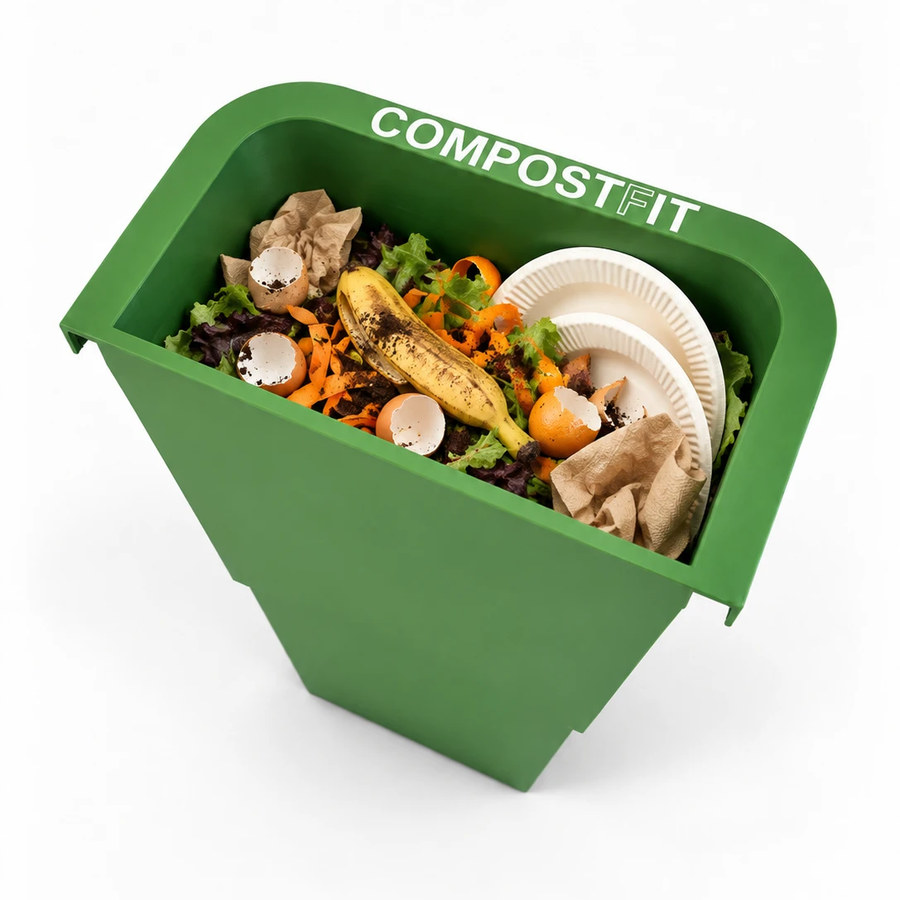
That's exactly what CompostFit was designed for. It's a compost insert that drops into a Rev-A-Shelf RV-35 or RV-50 pull-out trash can and takes about a third of it. Your trash bag tucks under its rim; food scraps and paper go in the compost side. To empty it, lift it straight out and dump it into the green cart; to clean it, separate the two pieces and run them through the dishwasher. Check if your trash can fits.
Outside California
California isn't alone. Several states have organic waste laws or landfill restrictions on food scraps — including Washington, Oregon, New York and Vermont — and many cities offer curbside food-scrap collection. Even without a mandate, the same kitchen setup works with a backyard compost pile or a drop-off program.
FAQ
Does SB 1383 apply to houses and apartments?
Yes. SB 1383 applies to every resident and business in California, including single-family homes and apartment buildings. How you separate organics — a green cart, a shared bin, or another system — depends on your city and hauler.
Can I be fined for not composting under SB 1383?
Enforcement is handled by your city or county. Haulers can issue contamination notices when organics end up in the trash or trash ends up in the green cart, and local rules can attach fees to repeated violations. Most programs start with education and warnings.
Do paper plates go in the green bin in California?
Food-soiled paper plates without a wax or plastic coating generally go in the green bin under SB 1383, along with napkins, paper towels and greasy pizza boxes. Coated or plastic-lined plates go in the trash. Check your hauler's list for local exceptions.
Do I need compostable bags for SB 1383?
No. SB 1383 requires separating organic waste, not bagging it. Some cities don't accept compostable bags at all, so many households empty food scraps loose into the green cart. CompostFit is designed to be used without any bag.
What is the easiest way to comply with SB 1383 at home?
Put a compost container right next to your trash, so sorting happens in the same motion as throwing something away, and make sure it is big enough for paper plates and napkins. If your kitchen has a Rev-A-Shelf RV-35 or RV-50 pull-out trash can, CompostFit adds a compost compartment inside it.
Make SB 1383 sorting automatic
CompostFit · $39.99 · Fits Rev-A-Shelf RV-35 & RV-50 · Dishwasher safe · Ships in 3–6 business days
Order CompostFit